Product Design by SU.
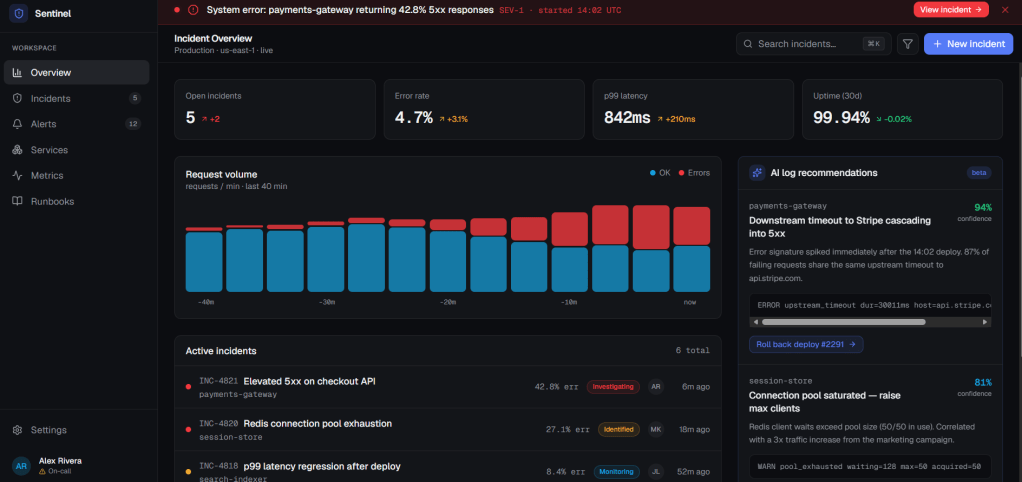
Here is the app Link: Sentinel — Incident Management
Security infrastructure is only as resilient as a human’s ability to understand it under pressure. Throughout my career in product design and my specialization in IT Security & Architecture, I have consistently noticed a dangerous pattern: the interfaces we rely on to protect our networks, servers, and cloud systems are actively driving us toward cognitive overload.
Today, the greatest paradox in IT infrastructure and security architecture is that while the underlying backend engineering has become incredibly sophisticated, the frontend interfaces remain remarkably primitive. Traditional enterprise interfaces—from complex legacy Firewalls and cluttered Cisco environments to modern SIEM platforms like Microsoft Sentinel—are dense, text-heavy, and poorly optimized for human intuition. Managing Identity and Access Management (IAM) through rigid Active Directory (AD) structures or convoluted cloud permission matrices often feels like deciphering a black box rather than navigating a secure system.
The Invisible Hazard in Infrastructure Architecture
This interface failure across IT infrastructure is not merely an aesthetic flaw. As infrastructure components—such as data centers, virtualization layers, network switches, and Kubernetes clusters—become deeply interconnected, their corresponding management dashboards swell uncontrollably. Enterprise architects build magnificent, robust systems; however, the control panels handed over to the engineers responsible for monitoring them are often nothing short of a data junkyard.
Sibersecurity teams face thousands of alerts daily. This phenomenon, known as „Alert Fatigue,“ becomes an operational catastrophe when paired with poorly designed infrastructure UIs. When a critical alert triggers, an engineer should not have to fight the user interface to uncover the root cause. When an analyst under extreme information bombardment misses a critical Indicator of Compromise (IoC) because it was buried under bad navigation, this ceases to be a design flaw—it becomes a direct security vulnerability. While cybercriminals execute lateral movement within a system in seconds, our engineers cannot afford to waste precious minutes digging through counterintuitive tabs and poorly mapped topology charts just to find the right button.
Good sibersecurity user experience (UX) should act as an invisible guardrail that prevents human error. When we simplify IAM dashboards or streamline AI-driven log suggestions, we do not just make a platform look better. By leveraging smart design, we significantly reduce human error, slash Mean Time to Resolution (MTTR), and fundamentally strengthen the entire defense ecosystem. Conversely, when system administrators get lost in labyrinthine AD trees or AWS/Azure permission pools, they naturally choose the path of least resistance. To bypass the friction of the UI, they frequently grant excessive privileges, effectively breaking Zero Trust protocols. Bad UX forces humans to take insecure shortcuts.
„Secure by Default“ and the Human Factor
This specific challenge is what inspired me to bridge the gap between design and cybersecurity. My focus is on transforming high-density technical infrastructure data into actionable clarity. By applying minimalist, high-performance design principles—deeply inspired by modern developer tools—we can drastically improve observability and architectural visibility across the enterprise.
Just as a fighter jet’s Heads-Up Display (HUD) is meticulously engineered to minimize cognitive load so the pilot can make split-second decisions under fire, the cybersecurity world must bring that same military-grade discipline to infrastructure design. Design is no longer just a luxury about aesthetics, layouts, and color palettes. In modern IT infrastructure and architecture, excellent UX is a core defense mechanism.


Kommentar verfassen